
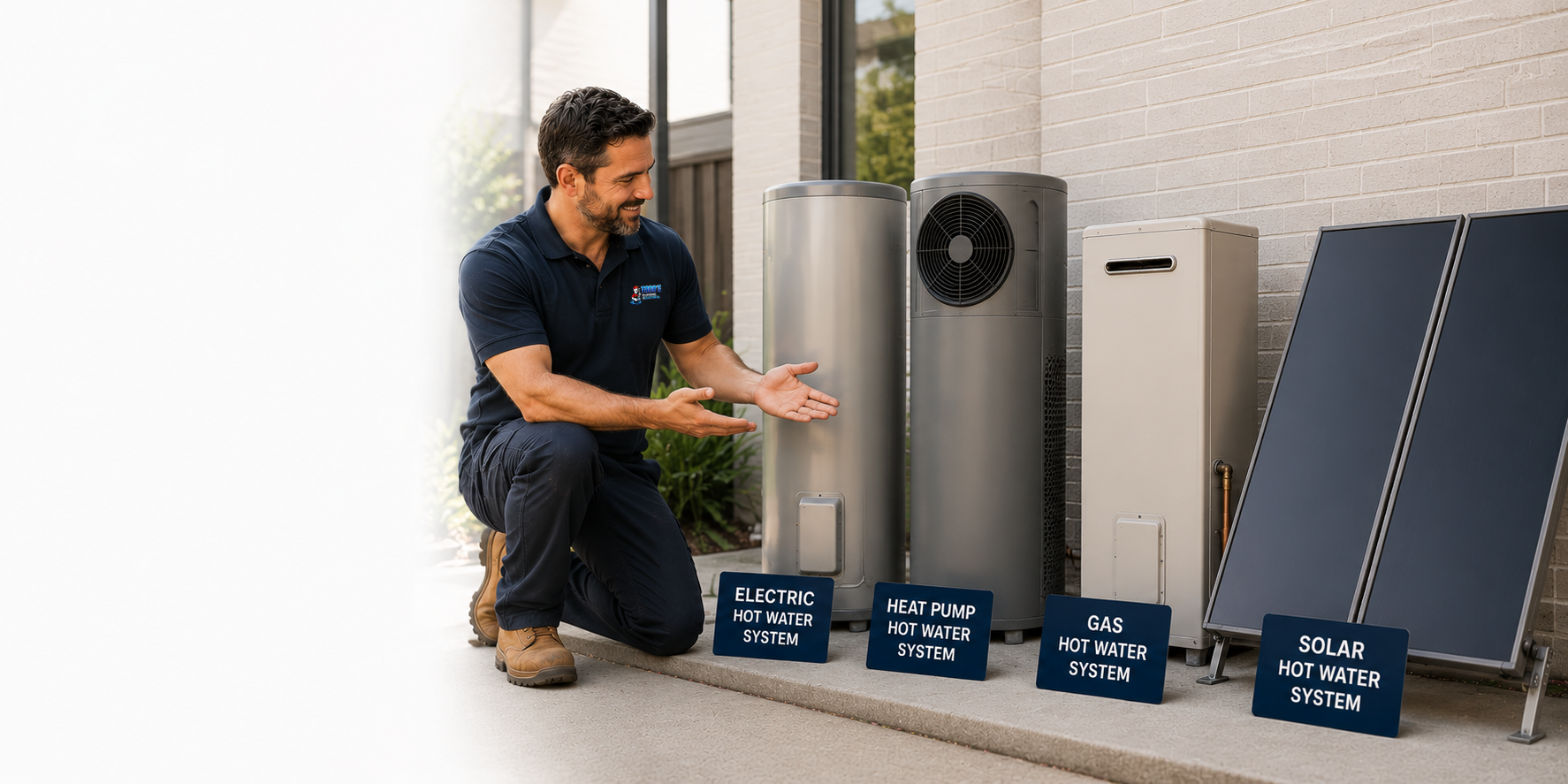
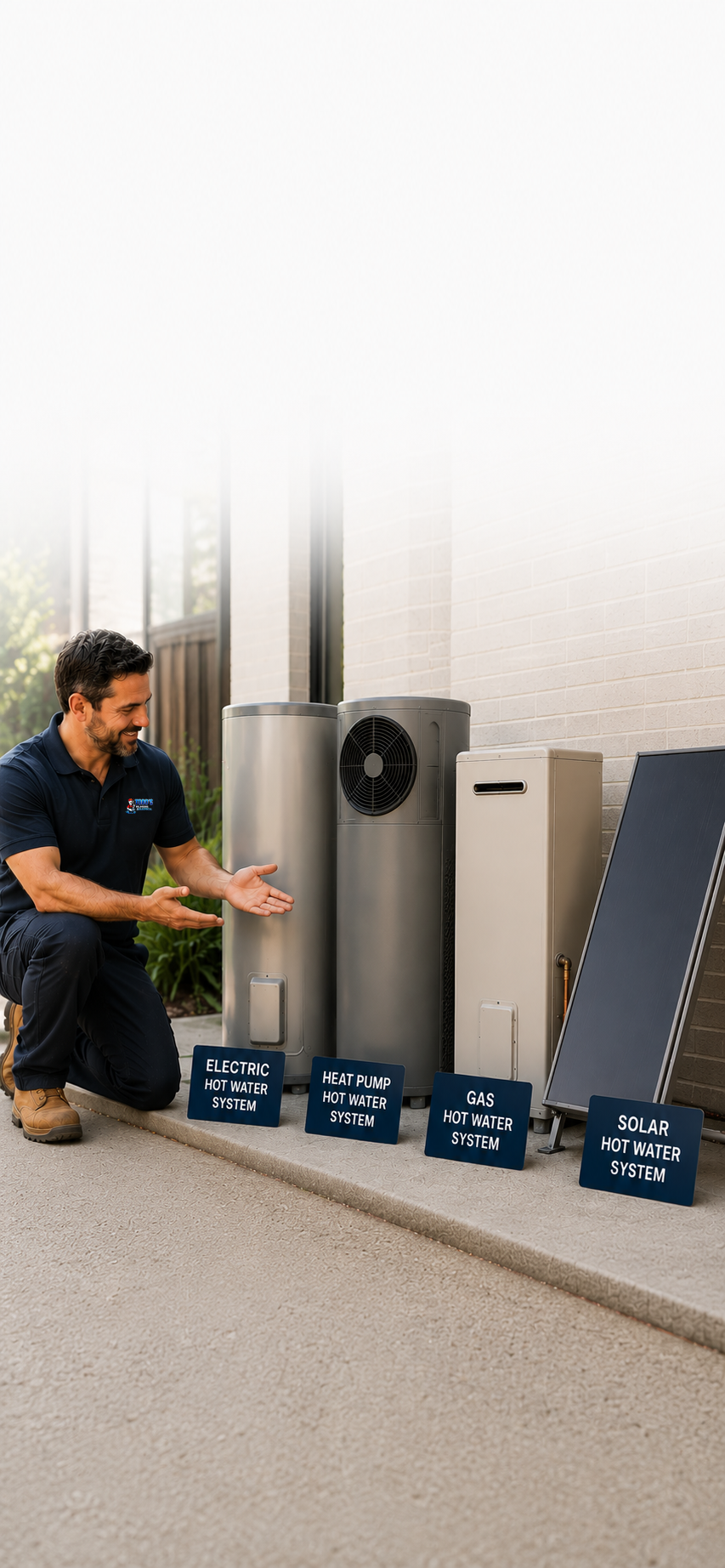
Best Hot Water System ForGold Coast Homes
Compare heat pumps, solar hot water, gas and electric systems to find the most efficient and cost-effective solution for your household.
What Is The Best Hot Water System For Gold Coast Homes?
For most Gold Coast households, heat pumps and solar hot water systems provide the lowest long-term running costs. However, the best system depends on household size, roof suitability, energy tariffs, budget and hot water usage patterns.
There is no single "best" system for everyone. The table below provides a quick guide, but every home deserves an individual assessment.
| Household Type | Recommended System |
|---|---|
| Small Household (1–2 people) | Small Heat Pump or Continuous Flow Gas |
| Family Home (3–4 people) | Heat Pump or Solar Hot Water |
| Large Family (5+ people) | Large Solar Hot Water or High-Recovery Heat Pump |
| Eco-Conscious Home | Solar Hot Water or Highly Efficient Heat Pump |
| Lowest Upfront Cost | Electric Storage (if replacing like-for-like) |
| Lowest Running Cost | Solar Hot Water (with optimal roof orientation) |
| Limited Roof Space | Heat Pump or Continuous Flow Gas |
| No Solar Access | Heat Pump (ground-level installation) |
Every home is different. Todd's Plumbing & Electrical can assess your property and provide tailored recommendations.
Types Of Hot Water Systems Available
Heat Pump Hot Water Systems
Heat pumps extract ambient heat from the surrounding air and transfer it into the water storage tank. They are highly efficient, using up to 70% less electricity than traditional electric storage systems. Because they run on electricity, they pair excellently with home solar PV systems, allowing you to heat your water using energy you've generated yourself.
- Advantages: Extremely low running costs, environmentally friendly, often eligible for government rebates, no roof collector required.
- Disadvantages: Higher upfront cost than standard electric, can produce some noise (similar to an air conditioner outdoor unit).
- Best for: Most Gold Coast homes, especially those already running rooftop solar but with limited roof space for thermal collectors.
- Typical lifespan: 10–15 years
Solar Hot Water Systems
Solar hot water systems use roof-mounted collectors — either flat panel or evacuated tube — to absorb the sun's energy directly. In Queensland's climate, they can provide free hot water for the majority of the year, relying on an electric or gas booster only during extended cloudy periods. For families on the Gold Coast, solar thermal systems consistently deliver the lowest long-term running costs of any technology.
- Advantages: Lowest possible running costs, excellent environmental benefits, long system lifespan, takes advantage of Gold Coast sunshine.
- Disadvantages: Higher upfront installation cost, requires unshaded north-facing roof space, roof-mounted tank adds visual weight.
- Best for: Medium to large families with good north-facing roof exposure who plan to stay in the home long-term.
- Typical lifespan: 15–25 years (collectors last longer than tanks)
Continuous Flow Gas Hot Water Systems
Also known as instantaneous or tankless gas systems, these units heat water only when a tap is opened. They never run out of hot water, take up minimal space, and avoid the standby heat losses associated with storage tanks. Brands like Rinnai and Bosch are commonly installed across the Gold Coast.
- Advantages: Endless hot water, compact size, no standby heat loss, lower upfront cost than solar.
- Disadvantages: Requires a gas connection, ongoing gas tariff exposure, slight delay before hot water reaches distant taps.
- Best for: Homes already connected to natural gas, households with very high or unpredictable peak demand.
- Typical lifespan: 15–20 years
Electric Storage Hot Water Systems
Traditional electric storage tanks use a heating element to warm stored water. They are the simplest and cheapest system to purchase and install, but carry the highest ongoing electricity costs of any technology. Unless powered by excess rooftop solar, standard electric storage is generally the least efficient choice for Gold Coast homeowners today.
- Advantages: Lowest upfront cost, simple installation, available everywhere, straightforward repairs.
- Disadvantages: Highest running costs, highest greenhouse gas emissions, less suitable as energy prices rise.
- Best for: Emergency replacements on a tight budget, or where other technologies are physically impossible to install.
- Typical lifespan: 8–12 years
Which Hot Water System Is Cheapest To Run?
Running costs vary significantly between system types. On the Gold Coast, where sunshine is abundant and electricity prices continue to rise, choosing an efficient system can save thousands of dollars over a decade.
| System Type | Relative Running Cost | Energy Efficiency |
|---|---|---|
| Solar Hot Water | Lowest | Excellent (free solar energy) |
| Heat Pump | Very Low | Excellent (300–500% efficient) |
| Continuous Flow Gas | Low–Medium | Good (no standby loss) |
| Electric Storage | Highest | Poor (100% efficient but expensive) |
Actual running costs depend on household usage, energy tariffs, shading, system size and orientation.
Heat Pump Vs Solar Hot Water
This is the most common comparison for Gold Coast homeowners upgrading to a more efficient system. Both are excellent choices for Queensland's climate, but they suit different homes. For a detailed breakdown, see our dedicated Heat Pump vs Solar Hot Water comparison page.
| Category | Heat Pump | Solar Hot Water |
|---|---|---|
| Upfront Cost | Medium | Higher |
| Running Cost | Very Low | Lowest |
| Roof Required | No | Yes (north-facing) |
| Pairs With Solar PV | Excellent | N/A |
| Lifespan | 10–15 years | 15–25 years |
| Maintenance | Low | Low–Medium |
| Winter Performance | Very Good | Good (booster assists) |
Choose a Heat Pump if:
- You already have solar panels (PV)
- Your roof is shaded or unsuitable for collectors
- You want a simpler installation
- You want a lower upfront cost than solar thermal
Choose Solar Hot Water if:
- You want the absolute lowest running costs
- You have a large, unshaded north-facing roof
- You plan to stay in the home for 10+ years
- You have a large family with high daily demand
Gas Vs Heat Pump Hot Water
For many years, continuous flow gas was considered the premium option for Gold Coast homes. Heat pumps have now surpassed gas systems in efficiency and long-term value for most households, particularly as electricity prices level out and gas tariffs continue to rise.
If your home already has gas connected and you're happy with your system's performance, a like-for-like gas replacement may make sense. If you're open to change, a heat pump will almost always offer lower running costs, especially if paired with rooftop solar power.
Best Hot Water System For Different Household Sizes
1–2 People
125–170L Heat Pump or Continuous Flow Gas
Smaller households don't need large tanks. A compact heat pump or continuous flow gas system will efficiently meet demand without wasting energy heating excess stored water.
3–4 People
200–250L Heat Pump or Solar Hot Water
This is the ideal size range for a heat pump or a standard solar hot water system. Both will comfortably meet daily demand and provide significant energy savings over a standard electric system.
5+ People
300L+ Solar Hot Water or Large Heat Pump
Larger families need systems with generous storage and fast recovery. A large solar hot water system or a high-capacity heat pump are both excellent options.
Multi-Generational Homes
Solar Hot Water or Multiple Units
Where there are elderly residents or very high daily demand, solar hot water provides a reliable, low-cost solution. In some cases, two smaller systems may perform better than one large unit.
Best Hot Water System For Gold Coast Conditions
The Gold Coast is one of the best locations in Australia for both solar thermal and heat pump technology. With over 280 days of sunshine annually, solar collectors achieve exceptional performance across the whole year. Heat pumps also operate at peak efficiency in our warm climate, as the warmer the ambient air, the less energy a heat pump needs to heat water.
Coastal areas like Labrador, Runaway Bay, Main Beach, Paradise Point and Hollywell do experience salt air. If you live in a coastal suburb, stainless steel tank construction is highly recommended to resist corrosion. Areas further inland including Mudgeeraba, Nerang, Robina and Pacific Pines don't face this concern to the same degree.
Suburbs like Helensvale, Hope Island, Coomera, Pimpama and Oxenford are largely newer housing developments where heat pumps have become the dominant replacement choice due to their efficiency and simple installation process.
Which Brands Perform Well In Australia?
Brand choice matters for long-term reliability and parts availability. The following brands are commonly installed throughout the Gold Coast and are all systems Todd's Plumbing & Electrical both installs and repairs.
Real-World Gold Coast Examples
Two people with moderate usage. No gas connected. Already have rooftop solar — the heat pump runs during the day using their own generated electricity, bringing running costs to near zero.
Good north-facing roof, four regular showers daily. The solar system covers over 80% of their annual hot water demand. The electric booster handles cloudy periods automatically.
Six people including teenagers. The roof was partially shaded by a large tree, making solar hot water less viable. A large heat pump provides the hot water capacity needed at low running cost.
Two people with low but consistent hot water use. Gas already connected. A continuous flow system avoids the wasted energy of keeping a tank warm all day. Simple and reliable.
The heat pump is programmed to run between 10am and 2pm, coinciding with peak solar generation. Essentially free hot water, funded by their existing rooftop solar system.
Most Common Mistakes When Choosing A Hot Water System
Choosing on purchase price alone
A cheap electric storage system saves money upfront but typically costs thousands more in running costs over its lifetime compared to a heat pump. Always consider total cost of ownership.
Undersizing the system
Buying a system too small for your household leads to cold showers, overworked components and premature failure. Always size for your peak demand.
Ignoring future household needs
If you're planning renovations, having children or expecting family to move in, choose a system that handles your future demand — not just your current situation.
Not considering running costs
A heat pump or solar system costing more upfront will almost always cost less to run. Over 10 years, the difference in electricity bills can easily exceed the difference in purchase price.
Installing in an unsuitable location
Heat pumps need adequate airflow. Solar collectors need unshaded, north-facing orientation. Installing in the wrong position significantly reduces efficiency and performance.
How Todd's Helps Homeowners Choose The Right System
At Todd's Plumbing & Electrical, we don't sell boxes — we find the right solution for your specific home and lifestyle. Our licensed plumbers, electricians and solar-accredited technicians assess your property and provide honest, unbiased recommendations.
Whether you're in Southport, Broadbeach, Ashmore, Benowa or anywhere across the Gold Coast, our team can visit your home and provide a clear recommendation with upfront pricing.
If your current system needs attention first, explore our Hot Water Repairs Gold Coast page, or see Should I Repair Or Replace My Hot Water System for help deciding whether repairs or a new system is the better investment.
Not Sure Which System Is Right For You?
Our experienced team serves all Gold Coast suburbs from Coomera and Pimpama in the north to Palm Beach and Currumbin in the south. Call us for honest, obligation-free advice.
Frequently Asked Questions
Common questions about choosing the best hot water system.
Get Your Fast Quote
Need a plumber or electrician fast? Fill out the form below with your details and what you need help with. We normally respond within minutes.
Urgent? Call or Text Us Directly
0482 080 423- No obligation quote
- Friendly local experts
- Upfront pricing guarantee