How to Tell If Your Hot Water System Needs Replacing or Just Repairing
Todd's Plumbing
Expert Author
Wondering whether your hot water system can be repaired or if it's time for a replacement? This guide covers the warning signs, when a repair makes sense, and when replacing is the smarter investment.
How to Tell If Your Hot Water System Needs Replacing or Just Repairing
Wondering whether your hot water system can be repaired or if it's time for a replacement? You're not alone. One of the most common questions we hear at Todd's Plumbing & Electrical is, "Can it be fixed, or do I need a new one?"
The answer depends on several factors, including the age of the system, where the fault is, the cost of repairs, and whether replacement will save you money over the long term.
In this guide, we'll explain the warning signs to look for, when a repair is the smartest option, and when replacing your hot water system will provide better value.
Quick Answer
In general:
- Repair your hot water system if it is relatively new, the fault is minor, and the tank itself is still in good condition.
- Replace your hot water system if the tank is leaking, it's over 10–15 years old, requires expensive repairs, or is becoming unreliable.
Our licensed plumbers and electricians inspect your system first and provide honest advice based on what's best for you—not what's most expensive.
The First Question: Where Is It Leaking?
Many homeowners assume a leaking hot water system means the whole unit needs replacing. That's not always true. Some leaks are inexpensive to repair, while others mean the storage tank has reached the end of its life.
Common repairable leaks include:
- Pressure relief valves
- Tempering valves
- Drain valves
- Pipe connections
- Flexible hoses
- Gas fittings
- Solar pipework
- Heat pump plumbing connections
These components can often be replaced without changing the entire system. However, if the leak is coming directly from the storage tank, replacement is almost always required.
Sign #1 – Your Tank Is Leaking
A leaking storage tank is usually the clearest indication that replacement is necessary. Inside most hot water systems is either a glass-lined steel tank or a stainless steel tank. Over time, corrosion eventually damages the internal tank.
Unfortunately, once the storage cylinder itself leaks:
- It cannot be welded safely
- It cannot be patched permanently
- Internal corrosion will continue to worsen
In these situations, replacing the entire unit is the safest and most cost-effective solution.
Sign #2 – Your Hot Water System Is More Than 10–15 Years Old
Age alone doesn't always mean replacement. However, once systems reach around:
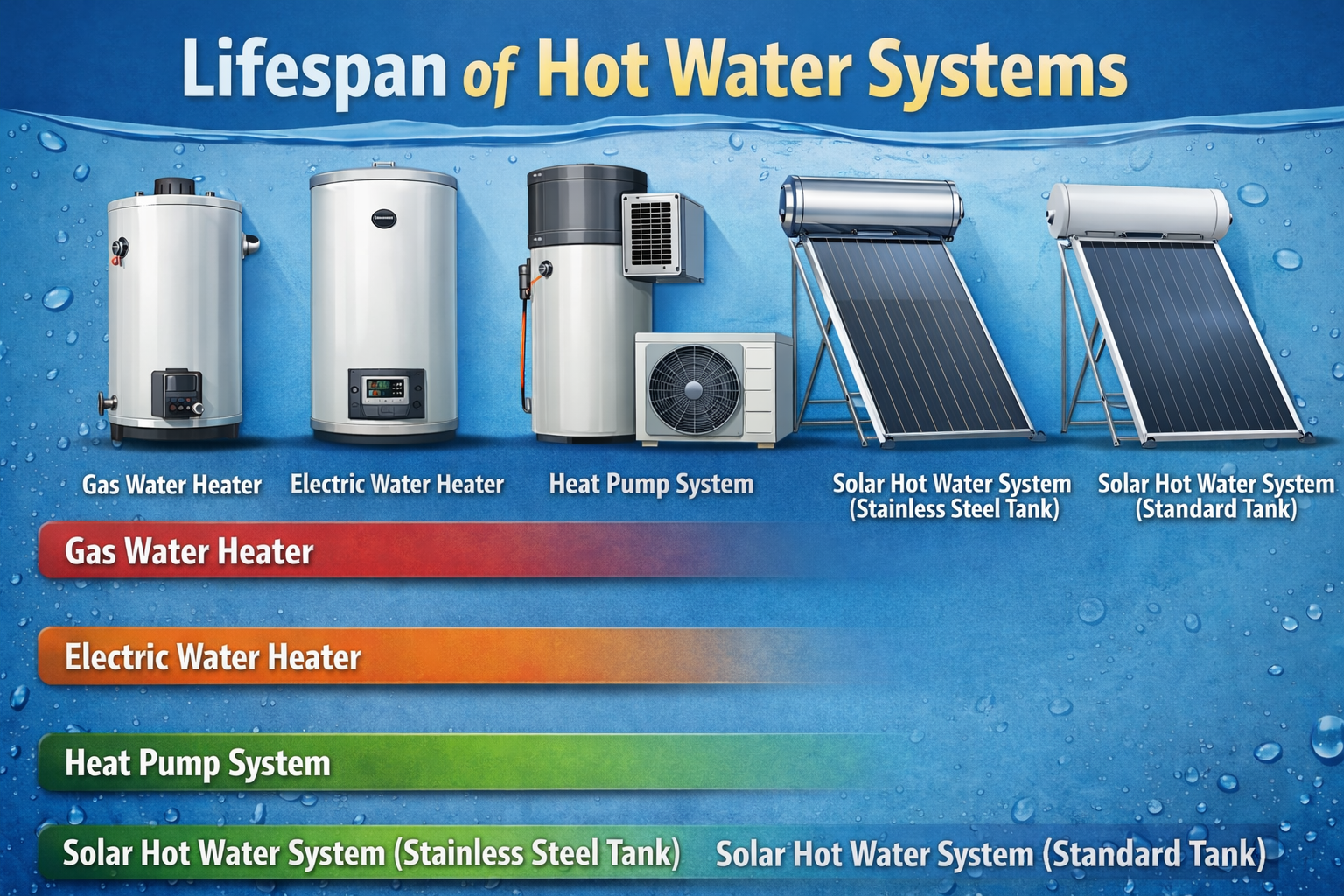
- Electric systems: 10–15 years
- Gas storage systems: 10–15 years
- Heat pumps: 10–15 years
- Solar hot water systems: 12–20 years (depending on maintenance)
The likelihood of expensive failures increases significantly. Components begin wearing out, including thermostats, heating elements, pumps, electronic controllers, valves, heat exchangers, and anodes. If multiple parts begin failing, replacement usually becomes the more economical choice.
Sign #3 – You're Constantly Paying for Repairs
One repair every few years isn't unusual. However, if you're calling a plumber every 6–12 months, the repair costs quickly add up. You might replace the element this year, the thermostat next year, the relief valve the following year, and the tempering valve after that. Eventually you've spent thousands maintaining an ageing unit.
Replacing the system often provides lower running costs, better reliability, a new warranty, and improved energy efficiency.
Sign #4 – Your Water Never Gets Properly Hot
If your water is only lukewarm, several faults could be responsible. Repairable causes include burnt heating elements, faulty thermostats, blown fuses, electrical faults, gas ignition problems, heat pump sensor faults, and solar controller faults. These are usually worth repairing. However, if multiple components have failed on an ageing system, replacement may be the smarter investment.
Sign #5 – Your Electricity Bills Keep Increasing
Older hot water systems often become less efficient. This can happen because heating elements become coated in mineral deposits, tanks lose insulation performance, heat pumps lose efficiency, solar systems stop collecting enough heat, and controllers no longer optimise heating cycles.
Many homeowners are surprised how much money a modern heat pump can save. Modern heat pump systems can reduce hot water energy consumption by up to 70% compared with conventional electric storage systems.
Sign #6 – Rusty Water Coming From Your Hot Taps
Brown or rusty hot water can indicate a corroding internal tank, a failed sacrificial anode, or rust inside steel components. If replacing the anode early enough, the tank may continue operating for years. However, once corrosion affects the tank itself, replacement becomes unavoidable.
Sign #7 – Strange Noises
Hot water systems should operate relatively quietly. If you hear rumbling, popping, cracking, banging, or hissing, mineral deposits may have built up inside the tank. In some cases, servicing can restore performance. If the tank is old and heavily scaled, replacement may provide better long-term value.
Sign #8 – Not Enough Hot Water
Running out of hot water isn't always a fault. Sometimes your family has simply outgrown the original system. For example, a 160-litre system installed 15 years ago for a couple may now be serving a family of five. Rather than repairing the existing unit, upgrading to a larger, more efficient model may solve the problem permanently.
When Repairing Makes Sense
We usually recommend repairing when:
- The tank is not leaking
- The system is under 10 years old
- Only one component has failed
- Parts are readily available
- The repair cost is reasonable
Common repairs include heating elements, thermostats, relief valves, tempering valves, gas controls, igniters, circulation pumps, solar controllers, heat pump fans, and pipework repairs. These repairs can often extend the life of your system for many years.
When Replacement Makes More Sense
Replacement is usually the better investment when:
- The storage tank is leaking
- The system is very old
- Repair costs approach replacement cost
- Multiple components are failing
- Parts are obsolete
- Energy efficiency is poor
- Warranty has expired
- You want lower electricity bills
Repair vs Replacement Comparison
| Situation | Repair | Replace |
|---|---|---|
| Leaking valve | ✅ | |
| Faulty thermostat | ✅ | |
| Heating element failed | ✅ | |
| Pipe leaking | ✅ | |
| Tempering valve faulty | ✅ | |
| Controller failure (newer unit) | ✅ | |
| Leaking storage tank | ✅ | |
| Severe internal corrosion | ✅ | |
| Multiple major failures | ✅ | |
| Obsolete parts unavailable | ✅ | |
| System over 15 years old with repeated faults | ✅ |
Can You Upgrade Instead?
Many homeowners take the opportunity to upgrade rather than simply replacing like-for-like. Popular upgrades include:
Heat Pump Hot Water Systems
Benefits include up to 70% lower running costs, government rebates available, environmentally friendly operation, and excellent performance in Queensland conditions.
Solar Hot Water Systems
Ideal for homes with good roof access, high hot water usage, and long-term ownership plans.
Larger Storage Capacity
Growing family? Replacing a 125L or 160L tank with a larger system may eliminate hot water shortages permanently.
Why Professional Inspection Matters
Many faults that appear serious are actually inexpensive repairs. Likewise, some systems that appear repairable may already have internal tank corrosion. Our experienced technicians inspect tank condition, valves, heating components, electrical safety, gas safety, solar components, heat pump operation, pipework, pressure levels, and overall efficiency. We'll explain your options clearly so you can make an informed decision.
Why Choose Todd's Plumbing & Electrical?
For more than 23 years, Todd's Plumbing & Electrical has helped Gold Coast homeowners with honest advice and reliable hot water solutions. We service and repair electric, gas, heat pump, solar, and continuous flow systems. Our team can repair most major brands and, if replacement is the better option, we supply and install high-quality systems from Australia's leading manufacturers.
Why customers choose Todd's:
- Licensed plumbers, electricians and gas fitters
- Honest repair-first approach
- Upfront pricing
- Same-day service where available
- Emergency hot water repairs
- Temporary hot water systems available (subject to availability and eligibility)
- Workmanship guaranteed
- Hundreds of 5-star customer reviews
Frequently Asked Questions
Is it worth repairing a 15-year-old hot water system?
It depends on the condition of the tank. If the storage tank is still sound and the repair is relatively minor, it may be worthwhile. However, if the system has required several recent repairs or the tank shows signs of corrosion, replacement is often the better long-term investment.
Can a leaking hot water tank be repaired?
If the leak is coming from the tank itself, replacement is usually required. Leaks from valves, fittings or pipework can often be repaired.
How long should a hot water system last?
Most systems last between 10 and 15 years, although well-maintained stainless steel and solar systems may last longer.
Is replacing a hot water system more economical than repairing it?
When repair costs become significant or the system is nearing the end of its life, replacing it often reduces future maintenance costs and improves energy efficiency.
Should I upgrade to a heat pump?
If you're replacing an older electric storage system, a heat pump can substantially reduce running costs and may qualify for government incentives, making it an excellent option for many Gold Coast households.
Need Expert Advice?
If your hot water system has stopped working, is leaking, or you're unsure whether it should be repaired or replaced, Todd's Plumbing & Electrical can help. Our experienced team will assess your system, explain your options clearly, and recommend the most cost-effective solution for your home and budget. Whether it's a simple repair or a complete replacement, we'll make sure you have reliable hot water again as quickly as possible.
Contact Todd's Plumbing & Electrical today for honest advice, expert workmanship, and fast hot water solutions across the Gold Coast.