
Heat Pump vs Solar Hot Water vs Gas vs Electric — Which Is Best for Gold Coast Homes?
Heat Pump vs Solar Hot Water vs Gas vs Electric — Which Is Best for Gold Coast Homes?
Replacing a hot water system used to be a simple decision: electric if you had no gas, gas if you did. Today, Gold Coast homeowners face four genuine options — electric, gas, solar hot water, and heat pump — each with different upfront costs, running costs, lifespans, and suitability for different homes and households.
Making the wrong call is expensive. Hot water accounts for roughly 21–25% of a typical Australian household's energy bill, and the system you choose today will be running for the next 10–20 years. The difference between a well-matched choice and a poor one can add up to thousands of dollars over that period.
This guide gives you an honest, Gold Coast-specific breakdown of every option so you can make an informed decision — not one based on whoever answered the phone quickest or which brand happened to be in stock on the day your old system died.
Todd's has been installing and repairing all four types of hot water systems on the Gold Coast for over 23 years. We're the preferred Envirosun heat pump installers in the region. We have no financial incentive to recommend one system over another — just the experience to know what actually works best for different Gold Coast homes.
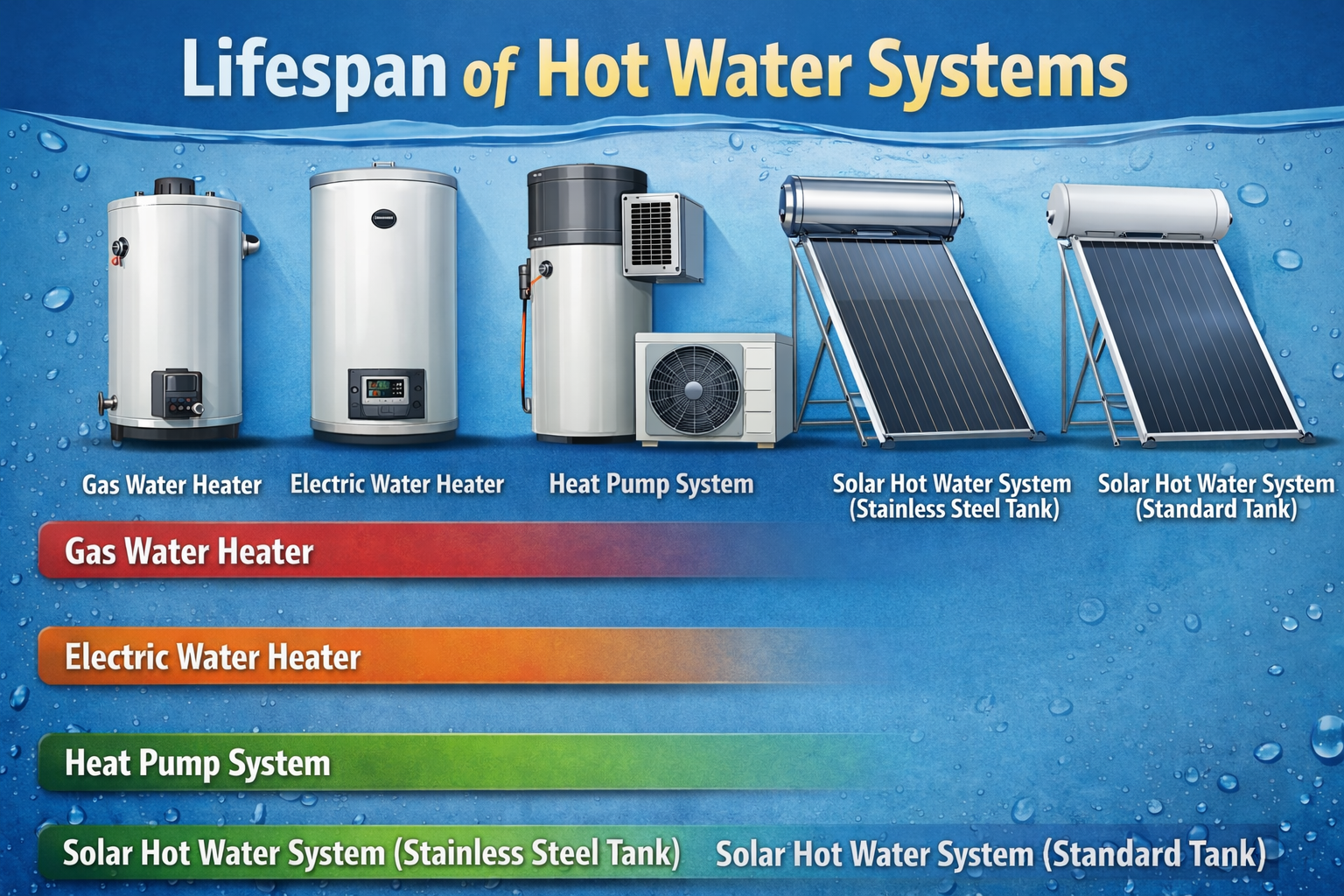
Why Your Location Matters More Than You Might Think
Before comparing systems, it's worth understanding why the Gold Coast is a particularly good location for energy-efficient hot water — and what that means for your decision.
The Gold Coast sits in Queensland's subtropical climate zone. We receive some of Australia's highest year-round solar radiation, with average daily sunshine hours well above the national average. Winter temperatures rarely fall below 10°C overnight, and our summers are long and warm. This climate is relevant to every system type:
For solar hot water: High sun hours mean the collectors are doing useful work almost every day of the year. The booster rarely needs to run during summer, and even in winter it only activates for part of the day. Gold Coast is one of Australia's best locations for solar hot water performance.
For heat pumps: Heat pumps extract warmth from the surrounding air. The warmer the air, the more efficiently they work. A heat pump running in Gold Coast's climate — where ambient air temperatures rarely drop below 10°C even overnight — operates at significantly higher efficiency than the same unit would in Melbourne or Canberra. On a typical Gold Coast day, a quality heat pump delivers three to four units of thermal energy for every unit of electricity it consumes.
For gas: The Gold Coast has good natural gas infrastructure across most of its established suburbs, though newer outer areas may be LPG-dependent or without gas entirely. Gas continuous flow systems are unaffected by weather, which is partly their appeal — but that advantage matters more in Melbourne than it does here.
For electric storage: The Gold Coast climate doesn't change the efficiency of a standard electric storage system — it still uses one unit of electricity to generate one unit of heat. The only weather-related opportunity is the ability to time it to run off solar PV panels during daylight hours, which can significantly reduce running costs.
Electric Hot Water — Cheap to Buy, Expensive to Run
Electric storage hot water systems are the most common type found in Queensland homes, largely because they're the simplest and cheapest to install. A new unit is typically straightforward to replace — same plumbing connections, same electrical supply.
How they work: One or two immersion elements inside a steel storage tank heat water and keep it hot until you need it. On off-peak tariffs (T31 or T33), the system heats overnight when electricity is cheapest.
Upfront cost: $600–$1,200 for the unit plus installation. The lowest of any system type.
Running cost: This is where electric storage falls short. On a standard tariff, a family of four can expect to pay $700–$900 per year to run an electric storage system. On an off-peak T33 tariff, costs fall to around $400–$600 per year — significantly better, but still higher than gas, solar, or heat pump over time.
Pros:
Lowest upfront cost
Simple installation — usually same-day
Reliable, few moving parts
Can be timed to run from rooftop solar PV during the day
Cons:
Highest running costs of all options
No rebate available (only solar and heat pump systems qualify for STCs)
In Queensland, if natural gas is available in your street, you are not permitted to install a new electric storage system under current regulations
Older systems with no off-peak tariff arrangement are expensive to run
Our honest assessment: Electric storage is the right choice when budget is the primary constraint and there's no gas available, or when the system is being installed temporarily pending a planned upgrade. For a long-term installation, the running cost penalty compared to heat pump or solar adds up to thousands of dollars over the system's life.
Gas Hot Water — Fast, Reliable, and Still a Strong Contender
Gas hot water has been the dominant choice for Gold Coast homes with gas access for decades — and for good reason. Gas continuous flow systems in particular are hard to beat for sheer convenience: the water heats the moment you turn on the tap, you never run out (there's no tank to empty), and the systems are compact enough to mount on an external wall.
How they work: Gas storage systems heat water in a tank using a gas burner, much like an electric system but with faster recovery. Gas continuous flow (instantaneous) systems heat water only when it's needed — cold water runs through a heat exchanger, the burner fires, and hot water comes out.
Upfront cost: $900–$1,800 for a gas continuous flow unit plus installation. Gas storage systems are in a similar range. If you're switching from a non-gas system, adding a new gas connection can add $2,000–$4,000 to the project.
Running cost: A family of four using natural gas continuous flow can expect annual hot water energy costs of roughly $350–$500. LPG is more expensive to run — typically 50–80% higher than natural gas, putting LPG running costs closer to electric storage in many scenarios.
Pros:
Unlimited hot water on demand (continuous flow)
Fast recovery on storage systems
Lower running costs than electric storage on natural gas
Works during power outages
15–20 year lifespan on continuous flow systems with proper servicing
Cons:
LPG running costs significantly higher than natural gas
Gas availability varies across newer Gold Coast suburbs
Higher emissions than heat pump or solar hot water
Gas prices have been rising and are expected to continue doing so as Australia transitions away from gas
Not eligible for STC rebates
Our honest assessment: For homes already on natural gas, a continuous flow system is a reliable and cost-effective choice, particularly for larger households with high simultaneous demand. For LPG-dependent homes, the running cost advantage narrows considerably and heat pump or solar is usually the better long-term investment.
Solar Hot Water — High Upfront, Low Running Costs, Gold Coast's Traditional Favourite
Solar hot water systems have been a Gold Coast staple for decades, and the region's climate genuinely suits them well. A properly functioning solar system on a north-facing Gold Coast roof can cover 70–90% of your household's hot water energy needs year-round.
How they work: Roof-mounted collector panels absorb heat from the sun and transfer it to a storage tank — either directly (thermosiphon/roof-mounted tank) or via a circulation pump (split system with ground-level tank). A booster — electric or gas — tops up the water when solar gain isn't sufficient.
Upfront cost: $2,500–$5,000 for supply and installation, depending on system type and tank size. After STC rebates (see below), the net cost is lower.
Running cost: With the Gold Coast's sun hours, a well-functioning solar system with an electric booster typically costs $100–$250 per year in boost energy. This is the lowest running cost of any system type in our climate — even slightly ahead of heat pump in pure solar terms.
Pros:
Lowest running costs in a sunny climate like the Gold Coast
Eligible for federal STC rebates ($800–$1,500 depending on system size)
In Queensland, eligible for the Climate Smart Energy Savers rebate ($800–$1,000)
Long-lived panels (15–20 years)
Environmentally friendly — minimal grid energy use in summer
Cons:
Higher upfront cost than electric or gas
More components exposed to weather (roof panels, circulation pump, valves) — more maintenance over system life
North-facing roof space required; shading or roof orientation can limit performance
Split system adds complexity and a circulation pump that can fail
Roof-mounted (thermosiphon) systems are heavy — roof structural integrity matters
On cloudy stretches, the booster does more work, raising running costs temporarily
Our honest assessment: Solar hot water is an excellent choice for Gold Coast homes with a good north-facing roof and no structural concerns. The Gold Coast's climate is one of the best in Australia for solar hot water performance. If your existing solar hot water system has reached end of life, replacing like-for-like is worth considering — particularly if the installation is straightforward.
Heat Pump — The Gold Coast's Sweet Spot in 2025
Heat pump hot water systems have grown rapidly in popularity across Australia, and for Gold Coast homes specifically, they represent an outstanding combination of efficiency, simplicity, and value.
How they work: A heat pump extracts warmth from the surrounding air using a refrigeration cycle — the same principle as a reverse-cycle air conditioner or a fridge running backwards. For every 1 unit of electricity consumed, a quality heat pump delivers 3–4 units of thermal energy to your hot water tank. This is the coefficient of performance (COP), and it's the reason heat pumps slash electricity bills compared to standard electric systems.
There's no roof installation required. The unit sits outdoors at ground level — beside the house, in a side passage, or in an open garage — with a storage tank attached. Installation is typically simpler and faster than solar hot water, and there are no roof components to maintain.
Upfront cost: $2,500–$4,500 for supply and installation before rebates. After STC rebates and the QLD Climate Smart Energy Savers rebate, net cost for many households comes to $1,500–$3,000.
Running cost: A family of four running a quality heat pump in Gold Coast's climate can expect annual hot water energy costs of $200–$400. In summer, when ambient air temperatures are warmest, efficiency is highest and costs are lowest. Even in Gold Coast's mild winters, heat pumps maintain strong efficiency — far better than the same unit would in a cold southern climate.
Pros:
60–70% lower running costs than electric storage
No roof installation or roof structural requirements
Eligible for federal STC rebates ($800–$1,200 depending on system)
Eligible for QLD Climate Smart Energy Savers rebate ($800–$1,000)
Combines exceptionally well with rooftop solar PV — the heat pump's low power draw (500–1,000W) means it can run almost entirely off your solar panels during the day
Fewer weather-exposed components than solar hot water — lower maintenance over system life
Suitable for homes without north-facing roof space or with shading issues
10–15 year lifespan
Cons:
Higher upfront cost than electric or gas storage
Requires outdoor space with adequate airflow (at least 1 metre clearance around unit)
Not suitable for apartments without ground-level outdoor access
Makes some operational noise — consider placement relative to bedrooms and neighbouring properties
Compressor repairs, if needed, can be costly
Our honest assessment: For most Gold Coast homes that don't already have natural gas, a heat pump is the best overall choice in 2025. The combination of low running costs, simpler installation than solar, strong government rebates, and excellent performance in our subtropical climate makes it hard to argue against. Paired with a rooftop solar PV system, it's even more compelling — a heat pump running off your own solar electricity reduces hot water running costs to almost zero.
Todd's are the Gold Coast's preferred Envirosun heat pump installers. Envirosun's Activ8 split heat pump system is specifically designed for Australian conditions, with strong cold-weather performance and a 5-year manufacturer's replacement warranty. We carry genuine parts, have direct manufacturer support, and have installed enough Envirosun systems across the Gold Coast to know exactly how to get the installation right.
Side-by-Side Comparison
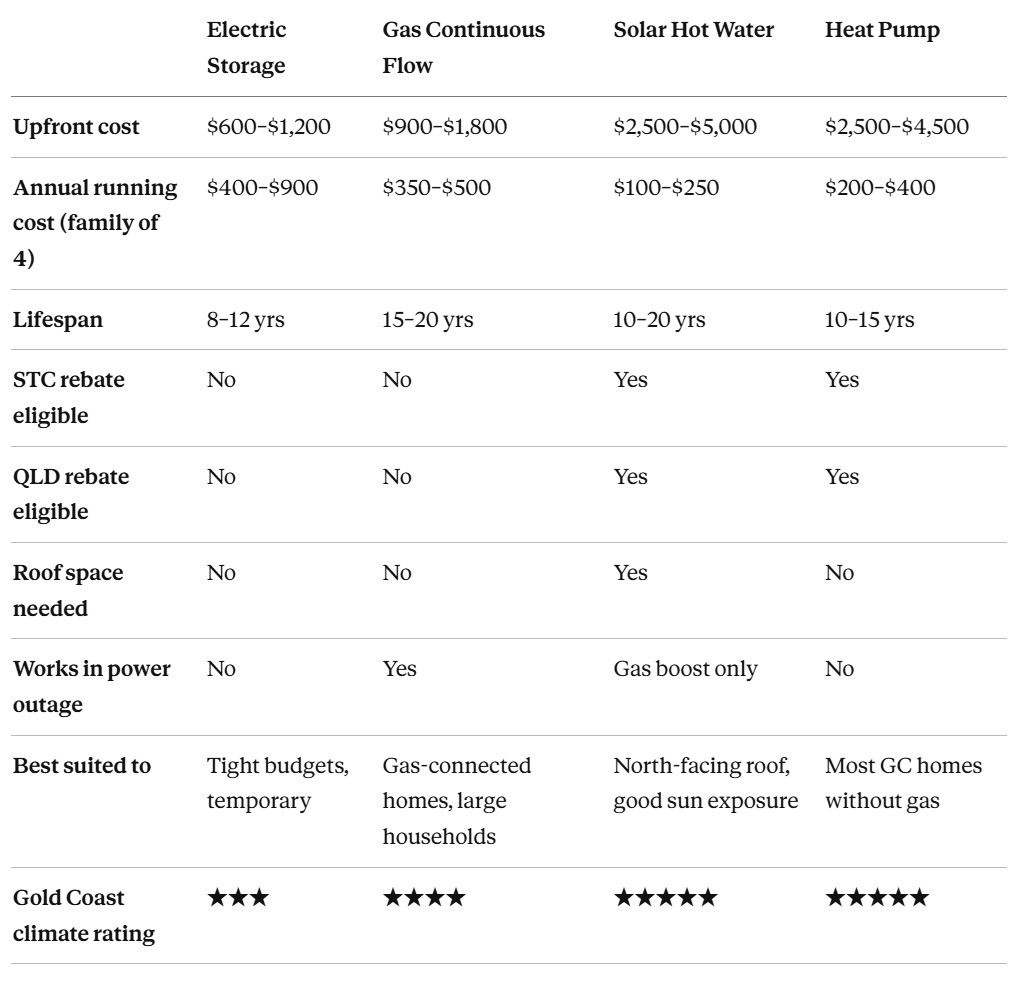
QLD Rebates and Incentives — What's Available Right Now
This is one of the most frequently changing aspects of hot water system purchasing, so always confirm current availability with your installer before making a decision. As of early 2026, the main incentives for Gold Coast homeowners are:
Federal Small-Scale Technology Certificates (STCs) Available for both solar hot water and heat pump systems. STCs are the most reliable and consistently available rebate — they've been part of the federal government's Renewable Energy Target since 2001. Your installer applies for STCs on your behalf and passes the value to you as an upfront discount on the purchase price. In QLD Zone 3 (which covers the Gold Coast), this typically reduces the cost of an eligible heat pump or solar system by $800–$1,200. The STC scheme is scheduled to phase down through to 2030, so the available discount reduces slightly each year.
Queensland Climate Smart Energy Savers Rebate A state government rebate of $800 (standard) or $1,000 (low-income households) for installing a 4-star-or-higher rated heat pump or solar hot water system. This rebate has had availability limits since its launch — check current status at qld.gov.au or ask Todd's to confirm availability at the time of your installation.
Stacking both rebates For eligible households, combining STCs and the QLD state rebate can reduce the effective upfront cost of a quality heat pump or solar system by $1,600–$2,200. This is a meaningful reduction that often brings the net cost of a heat pump installation in line with — or below — a comparable gas continuous flow installation.
Our Recommendation for Most Gold Coast Homes
Every home is different, and we'd never suggest there's a single right answer for every situation. But based on 23 years of installing and servicing every type of hot water system across the Gold Coast, here's our honest guidance:
If you're on natural gas and have a large household (4+ people): A gas continuous flow system remains a strong, proven choice. Unlimited hot water, fast recovery, and a 15–20 year lifespan with good servicing. The rising price trajectory of natural gas is worth factoring into your long-term thinking, but for now it's a solid option.
If you have a good north-facing roof with no shading: Solar hot water is still an outstanding choice in our climate — particularly if you already have a solar system on part of your roof and the remaining space suits a solar hot water collector. The running costs are the lowest of any option in Gold Coast conditions.
If you don't have natural gas, or you're replacing an old electric system, or your roof isn't suited to solar: A heat pump is our recommendation for most Gold Coast homes. The combination of low running costs, strong rebates, simple installation, and excellent performance in subtropical conditions makes it the best all-round choice for the majority of situations.
If you have rooftop solar PV and want the lowest possible running costs: A heat pump timed to run during the day from your solar panels is the optimal setup. Heat pumps draw only 500–1,000W, meaning they can run almost entirely off a typical 6.6kW rooftop solar system without affecting your other consumption.
If budget is the immediate constraint: An electric storage system on an off-peak tariff is still a viable interim solution — just know that the ongoing running cost penalty relative to a heat pump will exceed the upfront price difference within 3–5 years.
Key Takeaways
Gold Coast's subtropical climate makes it one of Australia's best locations for both solar hot water and heat pump performance
Heat pumps are the best all-round choice for most Gold Coast homes in 2025 — low running costs, no roof installation needed, strong rebates, and excellent efficiency in our climate
Solar hot water is still outstanding for homes with good north-facing roof space
Gas continuous flow suits large households already on natural gas; LPG running costs reduce the advantage significantly
Electric storage has the lowest upfront cost but the highest long-term running costs — upgrade when budget allows
Federal STCs and the QLD Climate Smart Energy Savers rebate can reduce the net cost of a heat pump or solar installation by $1,600–$2,200 for eligible households
Todd's are the Gold Coast's preferred Envirosun heat pump installers, with direct manufacturer support and genuine parts
FAQ
Q: Is the Gold Coast good for solar hot water? A: Yes — it's one of the best locations in Australia. High year-round sun hours mean the collectors do meaningful work almost every day, and even in winter the booster only needs to run for short periods. If your roof is suited (north-facing, no significant shading), solar hot water is an excellent investment.
Q: Heat pump vs solar hot water — which has lower running costs on the Gold Coast? A: In pure solar terms, a well-functioning solar hot water system in Gold Coast conditions can edge out a heat pump on annual running costs. But this assumes consistent performance, a well-maintained system, and a good roof orientation. A heat pump is more predictable year-round, requires less roof infrastructure, and when combined with a rooftop solar PV system that powers it during the day, can match or beat solar hot water on effective running costs. It's genuinely close in our climate — the better question is which suits your home's specific setup.
Q: Can I get a government rebate on a heat pump in Queensland? A: Yes. Federal STCs reduce the upfront cost of eligible heat pump systems by $800–$1,200 at the point of purchase — your installer handles this. The Queensland Climate Smart Energy Savers rebate provides an additional $800–$1,000 for eligible households. Combined, the rebates can reduce your net cost by $1,600–$2,200. Confirm current availability of the state rebate when booking, as it operates on allocated funding.
Q: Is gas hot water being phased out in Queensland? A: There are no current Queensland regulations phasing out gas hot water (unlike Victoria, which announced restrictions on new gas connections in some contexts). However, gas prices in Australia have been rising, and the long-term trajectory is toward electrification. If you're making a 15–20 year investment decision, it's worth factoring in the likelihood of continued gas price increases. For homes already on natural gas with existing pipework, a gas continuous flow system remains viable. For homes without gas access, installing a new gas connection specifically for a hot water system is harder to justify economically against a heat pump.
Q: What size heat pump do I need for my Gold Coast home? A: A 250-litre heat pump is typically sized for 2–4 people, and a 315-litre unit suits families of 4–6. Todd's will assess your household size, usage habits, and installation location and recommend the right size — an undersized system runs constantly and wears out faster, while an oversized one is unnecessary cost upfront.
Q: Does a heat pump work during a Gold Coast summer power outage? A: No — heat pumps require electricity to operate. If power continuity is a concern (unusual on the Gold Coast, but worth knowing), a gas continuous flow system is the only option that operates fully independently of the electricity grid.
Q: How noisy is a heat pump hot water system? A: A quality heat pump like the Envirosun Activ8 operates at around 45–50 decibels — similar to a quiet conversation or a refrigerator hum. Placement matters: avoid installing directly below a bedroom window or directly adjacent to a neighbour's fence. Todd's will advise on the best installation position for your property as part of every quote.
Conclusion
Choosing the right hot water system for your Gold Coast home isn't complicated once you have the right information — and it's a decision worth taking seriously, given you'll be living with it for the next decade or more.
For most homes, our recommendation is clear: if you're replacing an old electric system and your roof isn't suited to solar, a heat pump is the best investment you can make. The running cost savings compared to electric storage will exceed the price premium within a few years, and the available rebates make the upfront cost very manageable.
If you'd like a free, no-pressure assessment of your home's best option — including confirmation of the rebates you're eligible for — call Todd's on 0482 080 423 or request a free quote at toddsplumbing.com.au. We install all system types and will always recommend what's genuinely right for your situation.
