Tree Roots in Drains Gold Coast | Signs, Fixes & Prevention | Todd's
Tree Roots in Drains — What Gold Coast Homeowners Need to Know
Tree root intrusion is the single most common cause of serious, recurring drain blockages on the Gold Coast — and it's more prevalent here than in most other Australian cities. The reason is simple: our subtropical climate means trees grow almost year-round, root systems are larger and more aggressive than in cooler regions, and Gold Coast's established suburbs are full of mature trees that have had decades to find their way into the underground drainage network.
The challenge is that tree root blockages don't announce themselves the way a blocked toilet does. They develop slowly and silently over months or years, gradually restricting flow until the blockage is severe enough to produce noticeable symptoms. By the time a homeowner calls a plumber, the root mass inside the pipe is often substantial — and the underlying pipe may already be cracked or damaged.
This guide explains exactly how roots get into your drains, which Gold Coast trees are the most problematic, how to recognise the signs, what clearing and repair options are available, and what the law says when the tree causing the damage belongs to your neighbour.
Tree Root Intrusion — The Gold Coast's Number One Drain Problem
According to Queensland Urban Utilities, tree root damage is one of the most common causes of sewer blockages across southeast Queensland. On the Gold Coast specifically, the combination of subtropical year-round growth, high-density established suburbs, and significant populations of aggressive-root tree species creates a uniquely high-risk environment for residential drainage infrastructure.
Several factors make the Gold Coast particularly vulnerable:
Year-round root growth. Unlike cooler Australian cities where root growth slows significantly through winter, Gold Coast tree roots are active almost every month of the year. A root mass that's been cleared will typically re-establish itself faster in our climate than it would in Melbourne or Adelaide.
Dry spell behaviour. During Gold Coast's dry winters, roots actively and aggressively seek out moisture. Underground sewer pipes — which constantly carry warm, nutrient-rich wastewater — become particularly attractive targets. Root tips are drawn toward the moisture vapour that escapes from pipe joints and any hairline fractures, and once they find a gap, they push through.
Legacy pipe infrastructure. Homes built before the mid-1980s across Gold Coast's established suburbs — Labrador, Southport, Ashmore, Biggera Waters, Southport, Benowa, Chirn Park, Mermaid Beach, Miami, and many others — typically have clay or concrete sewer pipes with joints every 60 centimetres. Each joint is a potential root entry point. Cement or rubber joint seals deteriorate over time, particularly under the temperature cycling and soil movement that Gold Coast's climate creates.
How Tree Roots Get Into Your Pipes
Understanding the mechanism helps explain why root intrusion is so hard to prevent once established trees are present on or near your property.
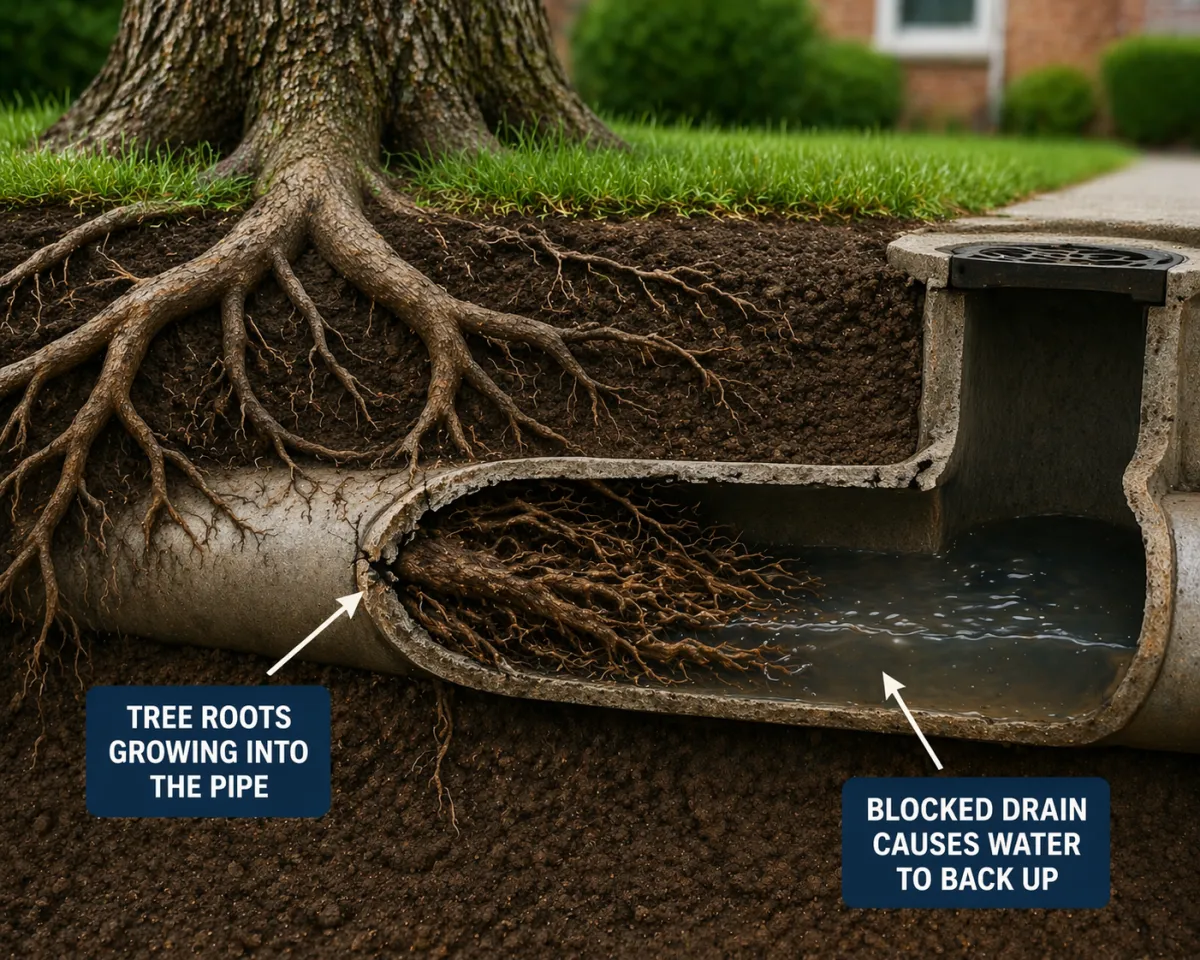
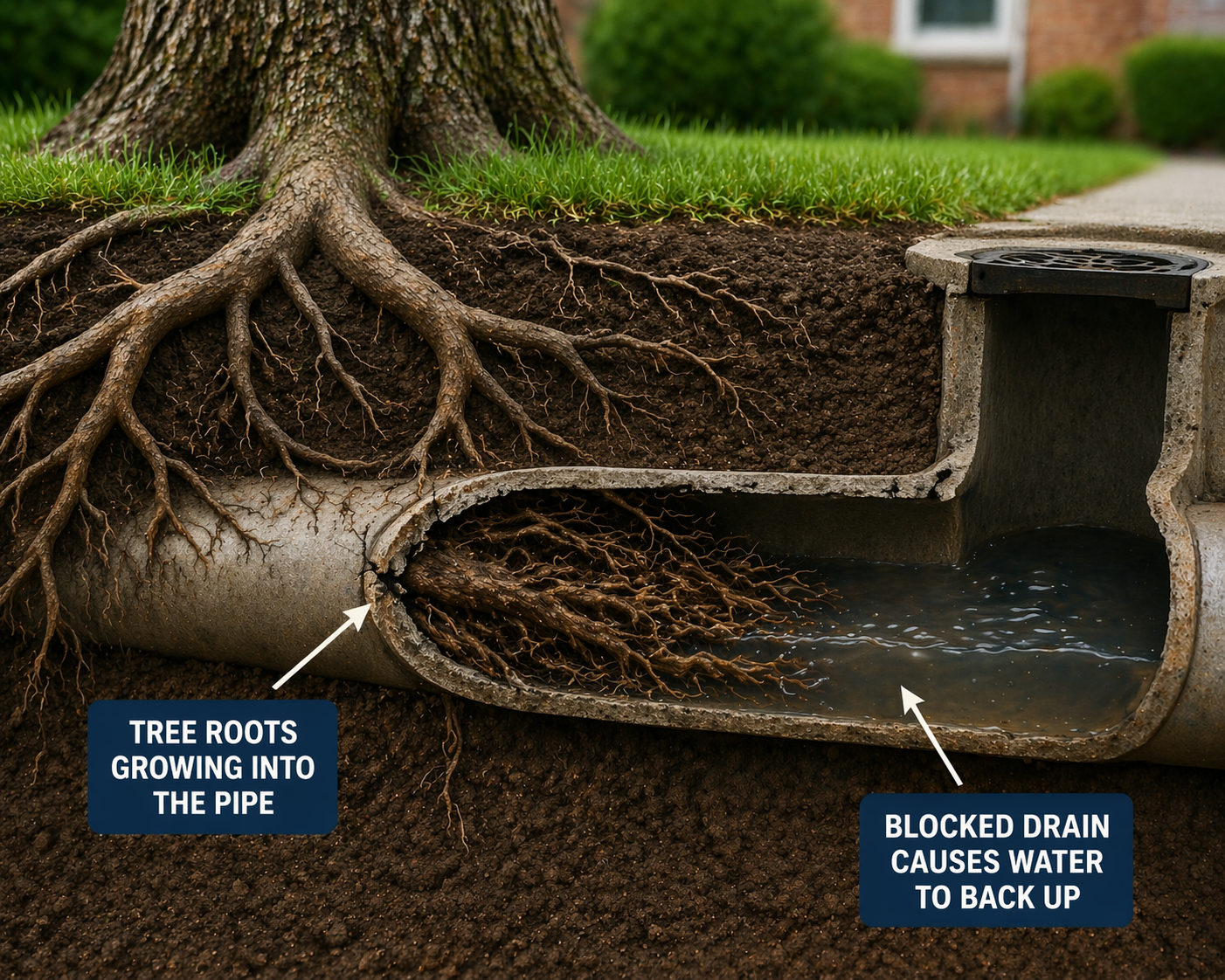
Every functioning sewer pipe leaks a small amount of warm, moist vapour through its joints and any micro-fractures. This vapour moves through the surrounding soil. Fine root tips — hair-thin at their growing end — detect moisture gradients in the soil and grow toward them. When a root tip encounters a pipe joint gap, a deteriorating rubber seal, or a hairline crack, it penetrates.
Once inside, the root is in a remarkable environment: constant moisture, warmth, and abundant nutrients from the wastewater. It grows rapidly, branching and filling available space. As the root mass expands, it traps toilet paper, grease, and organic debris passing through the pipe — creating a progressively denser obstruction that catches more material with every use.
Over months and years, what started as a few fine roots entering through a millimetre-wide joint gap becomes a root ball that occupies most of the pipe's internal diameter. Eventually it blocks completely.
A critical point that many homeowners don't realise: tree roots do not normally break open intact, healthy pipes. They exploit existing weakness — deteriorating joints, hairline cracks from ground movement, or pipe sections damaged during original installation. A pipe in perfect condition with properly sealed joints is largely root-resistant. The problem is that most pipes in Gold Coast's older suburbs are not in perfect condition after 30–50 years of service.
The Worst Offenders: Trees to Watch on the Gold Coast
Not all trees present equal risk. The following species have root systems that are particularly aggressive in seeking out moisture and are disproportionately represented in blocked drain call-outs across Gold Coast's established suburbs.
Moreton Bay Fig (Ficus macrophylla) A Gold Coast icon — and one of the most problematic trees for underground drainage anywhere in Australia. The Moreton Bay Fig's root system is famously extensive, typically extending two to three times the canopy width, and the roots are powerful enough to lift concrete paths and crack foundations. If you have a mature Moreton Bay Fig within 15–20 metres of your sewer line, it warrants a precautionary CCTV inspection. Common throughout older Gold Coast suburbs and many street plantings.
Camphor Laurel (Cinnamomum camphora) An introduced ornamental tree that has become invasive throughout Queensland. Camphor Laurels are particularly prevalent in Gold Coast's hinterland-adjacent suburbs — Mudgeeraba, Worongary, Nerang, Reedy Creek — where they were planted extensively through the 1970s and 1980s as shade trees. Their root system is vigorous and actively tracks moisture into drainage infrastructure.
Poinciana (Delonix regia) One of the most popular ornamental trees in Gold Coast gardens, famous for its spectacular red-orange flowering canopy. Beautiful above ground, problematic below it. Poinciana root systems spread widely and actively seek water sources. Common throughout established suburbs from the 1960s–1990s era, and a consistent source of drain intrusion call-outs.
Jacaranda (Jacaranda mimosifolia) Another Gold Coast favourite, planted extensively in suburban streets and gardens. Jacaranda root intrusion is a moderate rather than extreme risk, but the trees are so widespread that they collectively account for a significant share of root-related drain problems. Older properties with clay pipes are most vulnerable.
Bamboo If you or a neighbouring property have a clumping or running bamboo grove, it deserves attention as a drainage risk. Bamboo rhizomes (the underground root-like structures) are extremely invasive and fast-spreading, and they actively follow moisture gradients into drainage systems. If bamboo is growing within 5–10 metres of a drain line, have the system inspected.
Paperbark/Melaleuca Common in Gold Coast's wetter areas and frequently used in landscaping. Paperbark roots are highly aggressive moisture-seekers — their danger zone extends to approximately 1.5 times the tree height — and they're a particularly common cause of stormwater drain intrusion in properties near wetlands and low-lying areas.
Poinciana, Fig, Eucalyptus, Mango, and Bottlebrush are also regularly implicated in Gold Coast drain blockages, particularly on larger suburban blocks with mature garden plantings.
A note on pipe vulnerability by era:
Pre-1970s properties: Often have clay (earthenware) pipes with high porosity joints — the most vulnerable pipe type to root intrusion
1970s–mid-1980s properties: Mix of clay and early PVC — still significant root risk due to joint type and age-related degradation
Mid-1980s onwards: Generally PVC pipes with better-sealed joints — substantially more root-resistant, though still vulnerable where installation was imperfect or where ground movement has stressed joints
If your property was built before 1985 and you have any of the tree species above within 15 metres of your sewer line, a precautionary CCTV drain inspection is a sensible investment.
Signs Tree Roots Are in Your Drains
Root intrusion develops in stages, and the signs progress as the blockage worsens.
Early stage — roots present but flow not yet significantly restricted:
Occasional slow drainage, particularly after high-usage periods (morning rush, laundry day)
Faint gurgling from floor wastes when a toilet is flushed
A drain that used to flow freely now takes a moment to clear
Intermediate stage — root mass restricting flow:
Consistently slow drainage from one or more fixtures
Gurgling sounds from floor wastes or showers when a toilet is flushed (cross-fixture gurgling)
Occasional unpleasant smell from floor drains
Toilet that rises higher than usual before draining on flush
Advanced stage — severe restriction or near-complete blockage:
Drain backing up into fixtures
Toilet threatening to overflow with each flush
Multiple fixtures affected simultaneously
Overflow relief gully (the outdoor ground-level drain grate) overflowing or wet
Outdoor indicators:
A patch of lawn that is noticeably greener, lusher, or faster-growing in a line corresponding to where your sewer pipe runs — indicating the pipe is cracked and leaking nutrient-rich water into the soil
Wet or boggy ground in an area that should be dry
An unexplained sinkhole or slight ground subsidence along the pipe run
If you're seeing any of the intermediate or advanced signs, call Todd's for a same-day or next-morning inspection. Cross-fixture gurgling in particular is a reliable indicator that professional clearing is needed promptly — waiting until the drain fully blocks makes the clearing job harder and the risk of sewage backup much higher.
How Plumbers Diagnose and Clear Root Blockages
CCTV Drain Camera Inspection
A CCTV drain inspection is the essential starting point for any suspected or confirmed root intrusion. A waterproof camera on a flexible cable is inserted into the drain and navigated through the pipe, transmitting live video to a screen. The inspection identifies the location and extent of root intrusion, the condition of the pipe wall at and around the intrusion point, whether there are cracks, offsets, or collapsed sections that allowed entry, and whether multiple entry points exist along the pipe run.
This matters enormously because clearing the root mass without knowing the pipe's condition underneath leads to a recurring problem. Roots re-establish through the same entry point within 6–18 months if the crack or joint gap isn't addressed. CCTV inspection is what converts a temporary fix into a diagnosis that leads to a permanent solution.
Mechanical Root Cutting
A rotating blade attachment on a drain snake is driven through the pipe, cutting the root mass back to the pipe wall and restoring flow. Root cutting is fast and effective at clearing an active blockage. It's the right first step when you need the drain functioning again immediately.
The limitation is that root cutting is not a permanent solution. It doesn't remove root fragments from the pipe wall, and it doesn't address the entry point — the crack or joint gap through which the roots entered. Roots typically re-establish within 6–18 months after cutting alone. Root cutting is best understood as clearing the immediate blockage while providing time to plan a more permanent repair.
Hydro-Jetting
Following mechanical root cutting, high-pressure water jetting (2,000–4,000 psi) is used to flush root fragments and debris completely from the pipe diameter and clean the pipe wall. Jetting after cutting produces a cleaner pipe and extends the interval before roots re-establish compared to cutting alone. The two methods are most effective used in combination: cut first, then jet.
Pipe Relining — The Permanent Solution
Pipe relining, also called CIPP (Cured-in-Place Pipe) relining, is the permanent fix for root intrusion. It works as follows: after the root mass has been cleared and the pipe interior cleaned, a flexible liner saturated with epoxy resin is inserted into the damaged pipe section. The liner is inflated to press against the pipe wall and then cured — either by ambient temperature, UV light, or steam — hardening into a new, seamless, root-proof pipe within the old one.
The result is a pipe that has no joints for roots to penetrate, no cracks or gaps at the previous entry points, and a smooth inner surface that reduces future debris accumulation. The epoxy liner is rated for 50+ years of service life. For Gold Coast properties with clay pipe infrastructure, pipe relining transforms a recurring maintenance problem into a resolved one.
The advantages over traditional excavation and pipe replacement are significant: no digging up your yard, driveway, or landscaping; no structural disruption to the property; faster completion; and in most residential cases, lower total cost than conventional replacement.
Pipe relining is not appropriate for every situation — a fully collapsed pipe section that can no longer hold its shape cannot be relined and requires excavation and replacement. CCTV inspection determines which sections are suitable candidates for relining versus those needing replacement. Todd's will always advise honestly on which approach is right for your specific situation.
Can You Stop Tree Roots From Coming Back?
Once roots have been cleared and the entry point has been relined, the immediate problem is resolved permanently. But there are still practical steps worth taking to reduce the ongoing risk across your property's entire drainage network.
Know your trees and their risk zones. Fig varieties have root danger zones extending 2–3 times the canopy width. Poincianas extend approximately 2 times the canopy width. Paperbarks extend to 1.5 times the tree height. If you have high-risk species within these zones of your sewer line, treat it as a monitoring priority even after clearing.
Schedule periodic CCTV inspections. For properties with mature high-risk trees, a CCTV inspection every 3–5 years allows early-stage root intrusion to be identified and cleared before it develops into a serious blockage or causes pipe damage. Early-stage clearing is significantly cheaper than emergency clearing of a full blockage.
Consider root barriers for new plantings. If you're planning to add trees to your garden, root barriers — rigid panels installed vertically in the soil between the planting location and your drainage lines — can redirect root growth away from the pipes. Discuss placement with your landscaper and let us know if you need your drainage line locations identified.
Choose lower-risk species for new plantings near drainage lines. Native species like Lemon Myrtle, Tulipwood, and Native Gardenia have less aggressive root systems than the high-risk species listed above. Ask your local nursery specifically about root behaviour before purchasing trees for areas near your drainage infrastructure.
Whose Responsibility Is It If the Roots Come From a Neighbour's Tree?
This is one of the most commonly asked questions we receive on root intrusion jobs — and the honest answer is that it's legally complex, with no simple universal rule.
The general principle in Queensland is that the sewer and drainage lines on your property are your responsibility to maintain and repair, regardless of the source of the roots that caused the damage. The reasoning is that roots don't break into intact, well-maintained pipes — they exploit existing deterioration. The Queensland position, reflected in how council utilities treat these disputes, is that if your pipes were properly maintained and root-resistant, the intrusion wouldn't have occurred.
Where a neighbour's tree is demonstrably causing damage to your property, Queensland's Neighbourhood Disputes (Dividing Fences and Trees) Act 2011 provides a legal avenue. This legislation covers roots causing damage, not just overhanging branches. The starting point is to notify your neighbour in writing of the problem — their legal responsibility begins from the point they're made aware of it. If the neighbour is unresponsive or disputes responsibility, the Queensland Civil and Administrative Tribunal (QCAT) can make binding orders.
Practical realities to understand:
CCTV inspection footage is essential documentation if you're pursuing a neighbour for contribution — it visually establishes that the root entered from a specific direction and identifies the tree species, which can be matched to your neighbour's planting
Even with compelling documentation, neighbour disputes over drain damage are often resolved through negotiation rather than legal proceedings, and mediation is frequently the faster and cheaper path
Council trees on a footpath or public reserve that are causing drain damage fall under the City of Gold Coast's responsibility — contact Council with your plumber's CCTV report documenting the intrusion source
The most important practical advice: get the drain fixed properly first, particularly if the blockage is causing sewage backup. The legal question of who ultimately pays can be pursued afterwards. A sewage backup inside your home is an immediate health hazard — don't leave it unaddressed while a neighbour dispute is resolved.
How Much Does Tree Root Drain Clearing Cost?
Costs vary depending on the severity of root intrusion, the access required, the length of pipe affected, and whether relining is needed. Here's a general guide to what's typically involved.
Root clearing (cutting plus hydro-jetting): This is the cost of the immediate clearing visit — diagnosing, cutting the root mass, and jetting the pipe clean. For a standard residential sewer line, this is a single visit job in most cases.
CCTV inspection: Usually quoted as a separate line item. Essential for understanding the pipe condition and planning a permanent solution. Some companies include it as part of the clearing quote — ask when booking.
Pipe relining: Quoted per linear metre of pipe to be relined, dependent on pipe diameter and access. For most Gold Coast residential properties, a partial reline of the affected section is significantly less expensive than full pipe replacement, and the comparison becomes even more favourable when you factor in the cost of excavating through paving, driveways, or established landscaping.
Todd's provides upfront, fixed-price quotes on all work before anything begins. We'll show you the CCTV footage, explain what we found, give you honest options, and let you decide. No pressure, no hidden costs.
Key Takeaways
Tree root intrusion is the leading cause of serious, recurring drain blockages on the Gold Coast — our subtropical climate, year-round root growth, and legacy clay pipe infrastructure make SEQ one of Australia's highest-risk regions
Roots don't break into healthy pipes — they enter through deteriorating joints, hairline cracks, and poorly sealed sections, which are common in pre-1985 Gold Coast properties
The worst offenders are Moreton Bay Fig, Camphor Laurel, Poinciana, Jacaranda, Bamboo, and Paperbark — all extremely common in Gold Coast's established suburbs
Mechanical root cutting clears the immediate blockage but roots re-establish within 6–18 months without addressing the entry point
Pipe relining is the permanent solution — a new, seamless, root-proof epoxy pipe inside the old one, rated 50+ years, with no excavation required in most cases
In Queensland, the Neighbourhood Disputes Act 2011 provides legal recourse where a neighbour's tree is demonstrably causing drain damage — but fix the drain first
Todd's carries CCTV cameras, root cutting equipment, hydro-jetting gear, and pipe relining capability across the Gold Coast and SEQ
FAQ
Q: My drain keeps blocking every 6–12 months after being cleared. Is it tree roots? A: Almost certainly. Recurring blockages at consistent intervals after clearing are the most reliable indicator of root intrusion. The roots are cleared but the entry point is left open, so they re-establish at the same location. CCTV inspection will confirm this and identify whether pipe relining is the appropriate permanent fix.
Q: How do I know if the tree roots are from my tree or my neighbour's? A: CCTV footage typically shows which direction the roots entered the pipe from, and combined with knowledge of what trees are in which positions relative to the pipe run, a plumber can usually make a reasonable assessment. This footage becomes your documentation if you need to pursue a legal or insurance claim.
Q: Can pipe relining be done on old clay pipes? A: Yes — clay pipe is one of the most common candidates for relining in Gold Coast's older suburbs. The epoxy liner adheres well to clay and effectively seals the deteriorating joints that allowed root entry. CCTV inspection confirms whether the pipe is structurally sound enough to be relined (rather than requiring replacement).
Q: Will relining mean I never have to deal with tree roots in my drains again? A: In the relined section, yes — the new epoxy pipe has no joints for roots to penetrate. However, if there are other sections of pipe on your property that haven't been relined, those remain vulnerable to root entry from different trees or different points on the same tree. Periodic CCTV inspections of the remaining pipe network are still worthwhile for older properties with large trees.
Q: Do I need to remove the tree to permanently fix the root problem? A: No — pipe relining seals the entry point from within the pipe, so the tree can remain. Removing the tree addresses the source but doesn't repair the damage already done to the pipe. In most cases, reline the pipe and leave the tree.
Q: How long does a pipe relining job take? A: For a standard residential section reline, most jobs are completed within a single day. The liner curing time varies by method (ambient, UV, or steam cure) but is typically a few hours. Your drains are back in service the same day in most cases.
Q: Is tree root drain clearing covered by home insurance? A: Generally, no — gradual damage caused by tree roots is typically excluded from standard home insurance policies as a maintenance issue rather than a sudden event. It's worth checking your specific policy, but don't rely on insurance coverage for root intrusion work. If the damage was caused by a council tree, a claim against the City of Gold Coast with CCTV documentation is a separate avenue worth pursuing.
Conclusion
Tree root intrusion is a problem that most Gold Coast homeowners will face at least once in the life of an older property — but it's not a problem you need to keep dealing with repeatedly. The combination of proper diagnosis through CCTV inspection, effective clearing, and permanent repair through pipe relining turns a recurring maintenance burden into a resolved issue.
Todd's Plumbing & Electrical has been clearing, repairing, and relining drain pipes across the Gold Coast and SEQ for over 23 years. Our licensed plumbers carry CCTV cameras, root cutting equipment, and hydro-jetting gear on every van. We provide upfront fixed pricing and honest advice on whether clearing alone, relining, or replacement is the right call for your situation.
Call 0482 080 423 for same-day service, or request a free quote at toddsplumbing.com.au.
