8 Signs Your Hot Water System Needs Replacing | Gold Coast | Todd's
8 Signs Your Hot Water System Needs Replacing (Not Just Repairing)
Most hot water systems don't fail suddenly. They give you warnings — sometimes for months — before they finally give up. The problem is that most of those warnings are easy to ignore or misread as something less serious.
The result is predictable: a perfectly avoidable emergency replacement on a Saturday morning, with no hot water for the weekend, a stressed-out household, and a rushed decision about what system to install next.
This guide walks through the eight clearest signs that your hot water system needs replacing — not patching up. It also covers the one repair versus replace rule we use with every customer, what makes Gold Coast homes specifically worth thinking about, and what the replacement process actually involves when you call Todd's.
Repair or Replace? The Decision Every Gold Coast Homeowner Eventually Faces
Before we get into the specific signs, it helps to have a clear framework for making this decision — because "it depends" isn't useful when you're standing in a cold shower at 6am.
Here's the rule Todd's uses: if the repair cost exceeds 50% of what a new, comparable system would cost, and the existing system is over eight years old, replacement is almost always the better financial decision.
Why? Because a system that's expensive to repair once is usually expensive to repair again within the next 12–18 months. You end up paying repair costs repeatedly on a system that's still failing — and eventually replacing it anyway, having spent good money on a temporary fix. Replacement gives you a manufacturer's warranty, higher efficiency, lower running costs from day one, and years of reliable performance.
That said, a single minor fault on a sound, younger system is almost always worth repairing. The signs below are specifically the ones that signal the system itself — not just a single component — is failing.
Sign 1: Your System Is Over 10 Years Old
Age is the single most reliable predictor of hot water system failure. It's not exciting, but it's true.
Electric and gas storage systems typically last 8–12 years. Gas continuous flow systems can reach 15–20 years with proper servicing. Heat pumps generally run for 10–15 years. Solar hot water panels can last 15–20 years, though the storage tank and booster components have shorter lives in line with standard storage systems.
Once your system passes its expected lifespan, several things happen simultaneously: the sacrificial anode rod is likely depleted or close to it, the tank lining has experienced years of thermal stress and mineral exposure, the heating element (on electric systems) is operating in a degraded environment, and the overall efficiency has dropped from its original specification.
This doesn't mean a 12-year-old system automatically needs replacing today. But it does mean that every fault from this point forward should be evaluated differently. A thermostat replacement on a 4-year-old system with a sound tank is a straightforward repair. The same replacement on a 13-year-old system with an unchecked anode is buying time on a system that's likely to present another fault within a year.
What to do: Check the manufacturer's label on the side of your unit for the installation date. If you can't find it, take a photo of the serial number and call us — we can usually determine the manufacture year from that. If your system is over 10 years old and showing any of the other signs on this list, it's time to plan a replacement rather than another repair.
Sign 2: The Water Coming From Your Hot Tap Is Rusty or Brown
This is the sign that most clearly indicates a specific, irreversible failure — and the one that homeowners most often try to explain away as "probably just the pipes."
Here's the test: run the cold tap at the same fixture. If the cold water runs clear but the hot water is discoloured, the problem is inside your hot water tank, not the pipes.
Every hot water storage tank contains a sacrificial anode rod — a metal rod, usually magnesium or aluminium, that corrodes intentionally over time to protect the steel tank lining. When the anode is fully consumed and hasn't been replaced, the tank itself begins to rust from the inside out. The rust particles dissolve into the water, producing the brown or reddish colour you're seeing.
Once internal corrosion has started, it cannot be reversed or repaired. The tank is failing. Continuing to use a rusting tank creates two problems: the water quality is genuinely unpleasant and will stain fixtures, tiles, and laundry, and the internal corrosion eventually leads to tank failure — either a slow leak or a sudden rupture.
If your hot water is accompanied by a foul or rotten egg smell, bacterial growth in the tank is likely alongside the corrosion — another clear signal the system has reached end of life.
What to do: Call Todd's for an inspection. If we confirm the tank is corroding internally, we'll give you honest replacement options including current pricing on heat pumps, solar, gas, and electric systems — and advise on the QLD rebates you're eligible for.
Sign 3: The Tank Is Leaking at the Base
Not all hot water leaks are equal. This distinction matters enormously.
Leaks from valves — the TPR valve, tempering valve, or inlet/outlet connections — are generally repairable. These are components that can be replaced without touching the tank itself, and on a system under ten years old with no other symptoms, a valve leak is often a straightforward repair job.
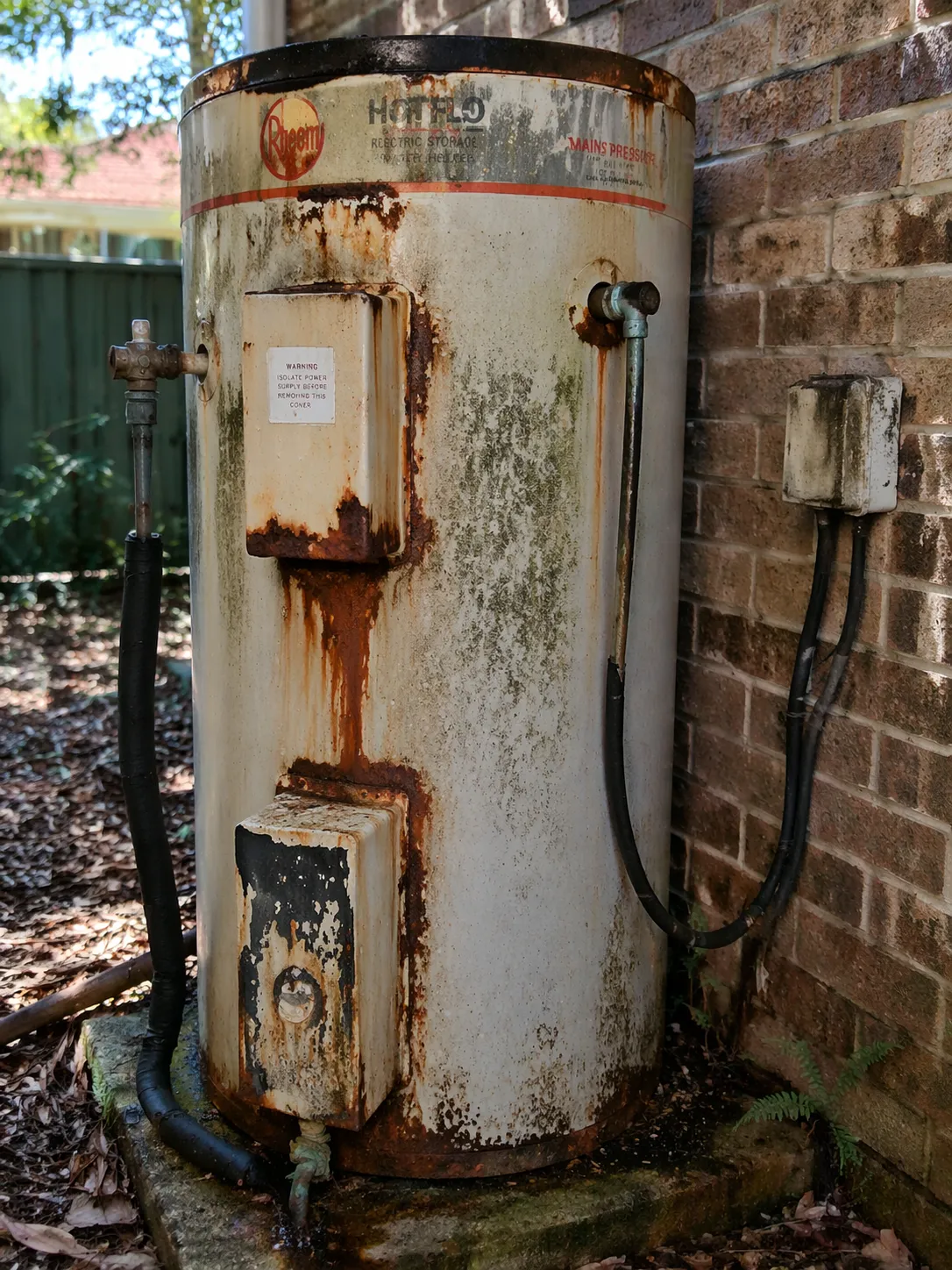
Leaks from the base of the tank body are a fundamentally different situation. When water is seeping from the tank itself — not from any attached valve or fitting — it means the steel tank wall has failed. This is caused by internal corrosion eating through the tank lining over time. It cannot be patched. It cannot be welded. The tank needs replacing.
Even a small, slow leak at the base warrants urgent attention for two reasons. First, "small and slow" can become "fast and flooding" without warning — we've attended jobs where a weeping tank base soaked an entire laundry floor overnight. Second, prolonged water exposure to the surrounding area causes damage to flooring, subfloor timbers, and wall frames that is often far more expensive to remediate than the hot water system itself.
A note for Gold Coast homeowners in beachside suburbs: salt-laden coastal air accelerates external corrosion on outdoor-installed tanks. It's worth periodically checking the base of your unit for surface rust or early weeping, particularly on systems over seven years old.
What to do: If water is pooling at the base of your tank, turn off the water supply to the unit and call us same-day. Don't leave it and hope it stops — it won't.
Sign 4: Loud Banging, Popping or Rumbling Sounds
A properly functioning hot water storage system is relatively quiet. Some occasional expansion sounds as metal heats and cools are normal — but persistent banging, popping, or deep rumbling during heating cycles is not.
These sounds are caused by sediment accumulation at the base of the tank. Gold Coast water is moderately hard, meaning it contains calcium and magnesium minerals that, over time, settle as scale on the tank base and heating element. When the element heats water trapped beneath this sediment layer, it creates steam bubbles that force through the hardened mineral crust — producing the cracking and popping sounds you're hearing.
This sediment layer causes three problems in parallel: it reduces the effective usable capacity of the tank, it forces the element to work significantly harder than designed (raising your electricity bill), and it accelerates wear on both the element and the tank lining itself.
In some cases, a professional flush can reduce the noise temporarily. But a system making consistent loud sounds has usually been accumulating sediment for years — and at that point the damage to the element and tank is often already done. If your system is over eight years old and making these noises, the economically rational decision is almost always replacement rather than repair.
What to do: If the noises are new or worsening, call us for an inspection. We'll assess the sediment situation honestly and tell you whether a flush buys meaningful time or whether replacement is the smarter call.
Sign 5: Your Energy Bills Are Rising Without an Obvious Cause
Your hot water system is responsible for roughly 21–25% of your home's total energy consumption. When it starts to degrade, that percentage climbs — quietly and consistently.
A system with significant sediment on the heating element has to run for longer and at higher temperature to achieve the same water temperature, because the sediment acts as an insulating barrier between the element and the water. A system with a degraded tank lining loses heat more quickly, meaning the element cycles on more frequently to maintain temperature. A solar hot water system with declining collector efficiency runs the electric booster for a larger proportion of the day.
None of these issues announce themselves dramatically. Your bills just creep up month by month — easily attributed to rising electricity prices or seasonal variation rather than a failing appliance.
The signal to watch for is a sustained increase in your electricity bill that doesn't correspond to a change in usage, new appliances, or a period of higher electricity prices. If your bill has gone up meaningfully over the past 12 months without a clear explanation, your hot water system is a primary suspect.
What to do: Check the age of your system and when it was last serviced. If it hasn't been serviced in over five years and you're seeing rising bills, an inspection is worthwhile. We can assess the system's actual efficiency and tell you whether servicing will recover it or whether a modern replacement — particularly a heat pump — would deliver immediate running cost savings.
Sign 6: You're Running Out of Hot Water Faster Than You Used To
If your household hasn't grown and your habits haven't changed, but you're running out of hot water midway through morning showers, something has changed inside the system.
The most common cause is sediment accumulation reducing the tank's effective capacity. Sediment settles at the base and occupies space that should be occupied by water — effectively reducing a 250-litre tank to something closer to 180 or 200 litres in practice. Combined with a degraded element that's slower to reheat, you get a system that holds less hot water and takes longer to recover.
On solar systems, running out faster than usual can mean the collectors are no longer performing at their rated efficiency — possibly due to scaled or fouled glazing, shading from nearby trees that have grown, or ageing evacuated tubes — meaning the booster is doing a larger share of the work, and if the booster element is also degraded, the system genuinely struggles to meet household demand.
A single occurrence of running out of hot water after a large household use can be normal. A consistent pattern of running short before everyone has showered is not — it signals either a capacity issue, an efficiency issue, or both.
What to do: Consider when the pattern started and whether anything changed around that time. If the system is over eight years old and the hot water shortage is consistent, call us for an inspection.
Sign 7: You've Needed More Than One Repair in the Past 12 Months
One repair in a few years is normal maintenance. Two or three repairs within a single year is a pattern — and patterns tell you something about the overall health of the system.
When multiple components fail in close succession, it's usually because the underlying conditions inside the tank — sediment build-up, depleted anode, degraded lining — are creating a harsh environment that's wearing through components faster than normal. Replacing each component as it fails is an expensive and ultimately futile exercise: you're continuously spending money on a system that's failing from the inside out, rather than addressing the cause.
The calculation is simple: add up what you've spent on repairs over the past 12 months. Compare that to what a quality replacement system would cost after applicable rebates. In most cases where multiple repairs have been needed, the cumulative repair spend is already approaching 30–50% of a replacement cost — and the next fault is already building inside the tank.
What to do: If you've had two or more repairs in the past year, call us for an honest assessment. We'll tell you plainly whether further repairs make sense or whether replacement is the financially rational choice.
Sign 8: Coastal Corrosion — A Gold Coast-Specific Warning Sign
This is the sign that no competing article covers, and it's relevant to a significant proportion of Gold Coast homeowners.
Properties within roughly 3–5 kilometres of the coastline experience substantially higher levels of atmospheric salt and moisture. This coastal air accelerates corrosion on all external metal components — the tank exterior, pipework fittings, valve bodies, electrical connections, and mounting brackets.
On a well-protected indoor installation, this is less of a concern. But the majority of Queensland hot water systems are installed outdoors — on side passages, under eaves, or against external walls — where they're directly exposed to the coastal air environment year-round.
What this means in practice: a hot water system in Surfers Paradise, Miami, Palm Beach, Burleigh Heads, or any coastal Gold Coast suburb may show signs of external corrosion — surface rust on the tank body, corroded valve connections, degraded pipework insulation — significantly earlier than the same system installed 20 kilometres inland. External corrosion doesn't necessarily indicate tank failure, but it does create additional entry points for moisture, accelerates the degradation of fittings and connections, and is a strong signal to have the system professionally inspected rather than ignored.
If you live within a few kilometres of the beach and your hot water system is showing visible rust on the exterior body or connections, don't dismiss it as cosmetic. Have it inspected.
What to do: If you're in a beachside suburb and your system is over seven years old, an inspection as part of a routine service visit is worthwhile — even if it's currently working. Catching early-stage corrosion before it becomes a failure is far cheaper than emergency replacement.
What Happens During a Hot Water Replacement with Todd's
Knowing what to expect makes the whole process less stressful. Here's exactly what happens when you call Todd's for a replacement.
Step 1: Free quote and honest advice. We'll ask about your current system, household size, whether you have gas or rooftop solar, and your budget. We'll recommend the right replacement system for your situation and give you upfront pricing on supply and installation — including applicable rebate amounts.
Step 2: Same-day or next-morning installation in most cases. We carry stock of the most common system types and sizes. For standard replacements, we can usually install the same day you call or the following morning.
Step 3: Full QBCC-compliant installation. Every Todd's installation meets current Queensland plumbing standards including correctly rated tempering valve, pressure limiting valve, expansion control, and compliant overflow discharge. We document everything — important for your home insurance and future resale.
Step 4: Old system removed. We remove and dispose of the old unit as part of every replacement job. You don't need to worry about disposal.
Step 5: Full system test before we leave. We test the new system completely before we go — water temperature, pressure, valve function — and walk you through the controls.
Key Takeaways
The 50% rule: if repair costs exceed half the price of a new system on a unit over eight years old, replacement is almost always the better financial decision
Rusty water and tank-base leaks are irreversible failure signs — replacement is the only solution
Sediment-related banging sounds, rising energy bills, and running out of hot water faster are signals the system's efficiency has degraded significantly
Multiple repairs in a single year is a reliable indicator the system is failing broadly, not just component by component
Gold Coast beachside homeowners should inspect outdoor systems for coastal corrosion from age seven onwards — salt air accelerates external degradation well ahead of the typical lifespan
Todd's provides same-day replacement across the Gold Coast with full QBCC-compliant installation, upfront pricing, and old unit removal included
FAQ
Q: My hot water system is 9 years old and leaking from a valve — should I repair or replace? A: A valve leak on a 9-year-old system with no other symptoms is generally worth repairing, provided we can confirm the tank itself is sound. If we inspect it and find the anode is depleted, the tank lining is showing corrosion, or other components are close to failure, we'll tell you honestly. At 9 years old, a full assessment alongside the repair makes good sense.
Q: How quickly can Todd's replace a hot water system? A: For most standard replacements — electric, gas continuous flow, or heat pump — same-day service is usually available. We carry common system sizes in stock. Solar system replacements may require slightly longer lead time depending on the model. Call us and we'll confirm availability for your specific situation.
Q: Are there rebates available when I replace my hot water system? A: Yes, for heat pump and solar systems. Federal STCs typically reduce the purchase price by $800–$1,200 at the point of sale — your installer handles this. The Queensland Climate Smart Energy Savers rebate provides an additional $800–$1,000 for eligible households replacing with a 4-star-or-higher rated system. These rebates can make upgrading to a heat pump significantly more affordable than replacing like-for-like with an electric storage system.
Q: My system is making loud noises but still producing hot water. Do I really need to replace it? A: Not necessarily immediately, but get it inspected. Consistent loud banging and popping is a sign of significant sediment build-up that's accelerating wear on the element and tank. Whether we recommend a flush to extend life or replacement will depend on the system's age, overall condition, and how the economics compare. We'll give you an honest answer.
Q: Do I have to replace my hot water system with the same type? A: Not at all. When your old system fails, it's the perfect opportunity to switch to a more efficient technology — particularly if you've been running an old electric storage system. Many Gold Coast homeowners use a replacement as the trigger to switch to a heat pump, often finding that the running cost savings begin to offset the upgrade cost within a few years.
Q: Can I just keep repairing my old system rather than replacing it? A: That's always your choice, and for younger systems in good condition, repair is often the right answer. But for systems showing multiple signs of failure or approaching the end of their expected lifespan, repeated repairs typically cost more over time than a planned replacement would have. We'll always give you both options and let you decide — there's no pressure from us.
Conclusion
Hot water system failure is almost never truly sudden — the signs are there if you know what to look for. Catching them early gives you time to plan a replacement properly: research your options, take advantage of available rebates, and avoid the stress and premium cost of an emergency replacement.
If your system is showing any of the signs in this guide, call Todd's for an honest inspection and assessment. We'll tell you plainly whether repair or replacement makes more sense for your situation, give you upfront pricing on both options, and if replacement is the right call, have your new system running the same day in most cases.
Call 0482 080 423 or request a free quote at toddsplumbing.com.au.
